

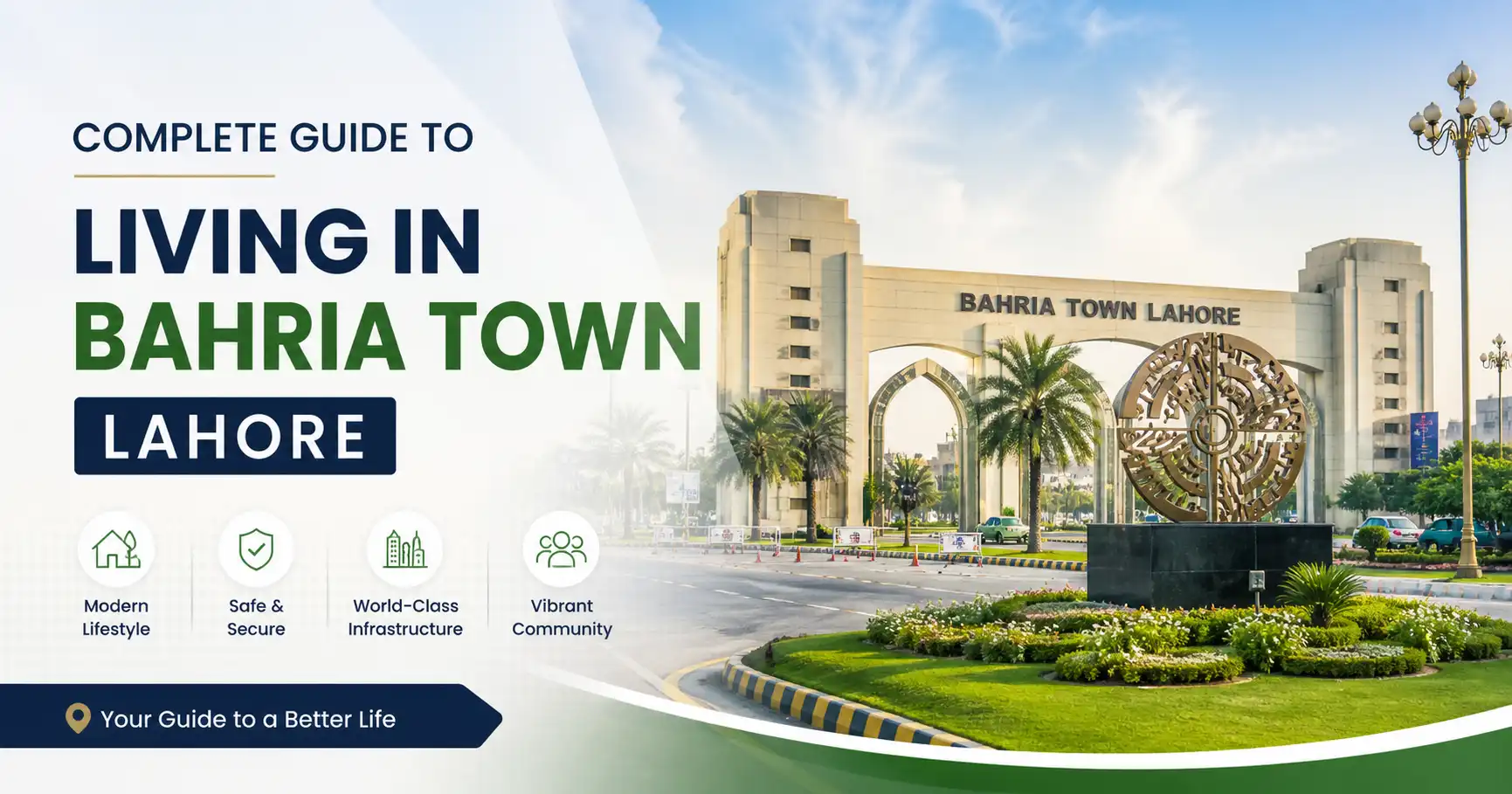
Complete Guide to Living in Bahria Town Lahore
- May 4, 2026
- 0
Bahria Town Lahore is unlike any other address in the city. It has its own roads, its own electricity supply, its own mosques, its own hospitals, and its own replica of the Eiffel Tower — and yet, for all that, moving here is a decision people think about carefully. This Bahria Town Lahore living guide covers everything honestly — from sectors and schools to property prices and daily life inside Pakistan's largest gated community — so whether you are considering making it your permanent home, evaluating it as an investment, or simply trying to understand what life inside actually looks like, you will find real answers here.
A Brief Overview — Bahria Town Lahore Living Guide
Bahria Town Pvt. Ltd., founded by Malik Riaz Hussain, launched its Lahore project in the early 2010s, making it one of the newer major housing societies in the city compared to older localities like Garden Town or Model Town. What it lacked in history, it made up for in scale. Today it is routinely described as a city within a city — six main sectors (A through F), dozens of sub-blocks, and a resident base that numbers in the hundreds of thousands.
The society was built without any government funding, which is a point its developers have always emphasised. Everything from roads and street lighting to electricity generation and water distribution is managed internally. Bahria Town even runs its own electricity supply company, providing power that is largely independent from the national grid — a significant draw for families tired of load-shedding.
The resident profile leans toward upper-middle and high-income households: business families, professionals, overseas Pakistanis who want a secure base in Lahore, and investors who have treated Bahria property as a long-term asset. It is the kind of society where your neighbour's car is likely a newer model than yours, and where the streets are swept every morning without anyone asking.
Location and How to Get Around
Bahria Town Lahore sits on Main Canal Road, with access also available through Multan Road and the Ring Road. From the main entrance at Thokar Niaz Baig, you can connect to the M-2 Motorway toward Islamabad fairly quickly. The Lahore International Airport is also a short drive away, which is one reason the society attracts overseas Pakistanis who travel frequently.
The honest part: Bahria Town is not central Lahore. If you work in Gulberg, Liberty, or anywhere in the older parts of the city, you are looking at a 25 to 40-minute drive on a good day — longer during rush hours. This is the single biggest trade-off residents talk about. The society is self-contained by design, but that containment works best when your daily life does not require you to cross the city repeatedly.
Inside the society, Bahria's own transport buses run to Thokar Niaz Baig from Safari Villas roundabout roughly every half hour between 6 am and 10:30 pm, connecting residents to the wider city's public transit. Ride-hailing apps like Uber and InDrive work within the society and to and from the main city, though availability can thin out late at night in the outer blocks. Most established families rely on their own vehicles — and those who prefer a dedicated driver will find it useful to read through this driver hiring guide for Lahore to understand what to look for before bringing someone on. If you don't drive and have no driver, daily mobility here requires some planning.
Sectors and Neighbourhoods Inside Bahria Town
Sector A is the oldest and most established part of Bahria Town Lahore. Known also as Babar Block, it was the original model for everything that came after — fully developed, with families who have been here since the beginning. Properties here are in high demand precisely because there's no construction dust and no waiting for infrastructure to catch up with residents.
Sector B sits next to the Executive Lodges and is completely built out. It has a strong residential character with parks, playgrounds, and the kind of quiet that comes when a neighbourhood has been settled for years. Families with young children tend to like it here.
Sector C is where Bahria Town does its commercial business. The Grand Jamia Mosque — one of the largest mosques in the world, with a capacity of 70,000 worshippers — is located here, and its presence shapes the entire sector's character. Sector C's blocks are named after flowers, and its main commercial activity makes it the busiest part of the society for daily errands and shopping.
Sector D, launched in 2011, was the first sector to get its own separate entrance directly on Canal Road. It is well-populated now, and families report it as one of the more complete sectors for day-to-day living. Sector E came a year later and is where Bahria Town placed most of its landmark attractions — the Eiffel Tower replica, the Grand Mall, and the upcoming international-standard Theme Park. It's the most photographed part of Bahria Town and draws visitors from outside the society regularly.
Sector F is the newest addition. Some of its blocks are fully developed; others are still getting there. Investors have been watching it closely because entry prices are lower than the more established sectors, but the trade-off is that you may be living next to a construction site for a year or two.
The Overseas Enclave, spread across blocks OVSA, OVSB, and OVSC, deserves a separate mention. It was specifically designed with overseas Pakistanis in mind — contemporary layouts, strong resale demand, and a community of people who understand the needs of families that split their time between Pakistan and abroad.
Shopping and Markets
For daily grocery needs, residents in the older blocks tend to head to Gardenia Market or Pakeeza Vegetable and Fruit Shop, both located in Gulmahar Block. There's also Freshly in Sector C on the Main Boulevard — a well-stocked store with frozen food, dairy, juices, bakery items, and personal care products. It's the kind of shop that saves you a trip outside the society for most everyday items.
For bigger shopping, Jasmine Grand Mall in Sector E is Bahria Town's most prominent retail destination. It houses clothing brands, food outlets, and anchor stores. The Grand Mall in the same sector also brings in mainstream Pakistani retail brands. Bahria Town's commercial zones across all sectors have banks, pharmacies, salons, mobile phone shops, and real estate offices operating out of purpose-built plazas — the full range of commercial services you'd expect in a modern urban area.
What Bahria Town doesn't quite replicate is the chaos and variety of an older Lahore bazaar. There's no equivalent of Anarkali or Liberty here. If you're someone who loves shopping local, browsing crowded markets, or hunting for specific tailors and fabric shops in century-old lanes, you'll make those trips into the city. But for routine needs, the society manages well.
Food and Restaurants
Monal Restaurant inside Jasmine Grand Mall is probably the most talked-about dining option in Bahria Town — it's a large, family-friendly restaurant that handles both weekday lunches and weekend family dinners without much fuss. Butt Biryani on Main Boulevard in Sector C is a reliable go-to for a quick, honest biryani that doesn't need any introduction in Lahore.
The food court areas around Theme Park Road and the commercial strips of Sectors C and E have expanded considerably over the past few years. You'll find major Pakistani fast food chains like Hardee's, Subway, and KFC along with local chains and independent cafés. For coffee, a handful of cafés have opened in the newer commercial blocks, catering to the younger crowd and remote workers who prefer a sit-down environment during the day.
The restaurant scene here is still growing. It doesn't yet have the depth or variety you'd find on MM Alam Road in Gulberg, but it's functional enough that most residents don't feel the need to drive into the city just for a meal. On weekends, families tend to eat within the society more often than not. And quite a few households — especially those with working parents or elderly family members — skip the restaurant run altogether and hire a home chef in Bahria Town instead, which has become a practical and increasingly common arrangement in the society. If you're open to it, you can also hire a cook in Lahore for home through verified platforms that list both full-time and part-time options.
Schools and Education
Bahria Town has built its own school network under the Bahria Town School and College banner, with campuses spread across multiple sectors. Beyond the society's own institutions, a number of well-known private school systems operate inside or immediately adjacent to Bahria Town:
- Beaconhouse School System
- The City School
- Roots International Schools
- LGS (Lahore Grammar School) campuses nearby
- ACE International Academy (a Bahria Town project)
- Bahria Education and Medical City (EMC) — which includes schools and college-level institutions
Families living in Sectors B, C, and the Overseas Enclave tend to have the easiest access to schools within reasonable distance. The society is large enough that if you're in one of the outer developing blocks, the commute to school — even within Bahria Town — can be 10 to 15 minutes by car.
There is no major university inside Bahria Town Lahore itself, so older students and young professionals typically head out to the city for degree-level education.
Hospitals and Healthcare
Bahria International Hospital is the flagship healthcare facility inside the society and handles most routine and intermediate medical needs. Beyond that, the society has:
- Dental and specialist clinics spread across the commercial blocks
- Pharmacies that operate 24 hours in the busier commercial areas
- Diagnostic centres for lab tests and imaging
The honest assessment: for day-to-day healthcare — a GP visit, a dental appointment, basic diagnostics — Bahria Town is adequately served. For serious specialist care or complex procedures, most residents travel to hospitals like Shaukat Khanum, Hameed Latif, or Doctors Hospital in the main city. This isn't a knock against Bahria Town specifically; it's simply the reality for most housing societies in Lahore that sit outside the older medical clusters. Families with elderly members at home also tend to look into finding a patient attendant in Lahore for in-home care, which reduces the need for frequent hospital visits altogether.
Parks, Recreation, and Community Life
Bahria Town's parks and green spaces are genuinely one of its strongest features. Wide walking tracks, maintained lawns, and properly lit pathways mean that early morning walks and evening jogs feel safe and pleasant in a way that's hard to replicate in older Lahore neighbourhoods. Each sector has its own dedicated park areas, and the landscaping throughout the society is maintained with a consistency you notice quickly when you've spent time in less managed areas.
The Eiffel Tower replica in Sector E has become a local landmark and a popular spot for families on weekends. CineGold Cinema, also inside the society, handles the entertainment needs of residents who'd rather not drive to a cinema in the city. The upcoming Bahria Theme Park — with a dolphin pool, roller coaster, and bowling alley — is still in development but has been anticipated for several years now.
Community life here has a particular flavour. The resident base is educated, fairly affluent, and security-conscious. There is less of the organic street-life energy you find in older Lahore neighbourhoods — no chai walas on corners, no impromptu cricket in the lane — but in its place is a quieter, more managed kind of community where neighbours tend to look out for each other and the security staff at the gates knows most residents by sight.
Property Prices and Real Estate
Bahria Town Lahore property prices have appreciated significantly since the society launched. For anyone using this Bahria Town Lahore living guide to evaluate investment potential, here is a realistic picture as of 2025:
A 5 Marla plot in a developing block can start from around Rs. 70 to 90 lakh, while the same size in a well-established sector like A or B will be considerably higher. 10 Marla plots in mid-tier sectors typically range between Rs. 1.8 crore and Rs. 3 crore. 1 Kanal plots in premium locations — Sector A, Golf View Residencia, or the Overseas Enclave — can go well above Rs. 5 to 7 crore.
Constructed houses carry a premium on top of plot prices. A 10 Marla house in a developed sector is likely to be listed upward of Rs. 3.5 to 4.5 crore depending on construction quality and location within the block. Rental yields are healthy, especially in the Overseas Enclave and Sector B, where demand from families relocating for work or overseas Pakistanis on visits keeps occupancy rates strong.
Sector F and the outer developing blocks offer lower entry points but require patience. The price appreciation potential is there, but you're buying into a timeline that may be 2 to 4 years before the neighbourhood feels properly settled.
Domestic Help and Home Services
A large proportion of Bahria Town households are run by working couples, single professionals, and families where both spouses maintain careers. That means the demand for reliable domestic staff — maids, cooks, drivers, babysitter, and patient attendants — is consistently high across the society.
The traditional way of finding domestic help in a gated community like Bahria Town was always through neighbour recommendations and word-of-mouth within block WhatsApp groups. That still happens, but it has real limits: you're dependent on who happens to be available within someone else's network, and there's rarely any formal vetting beyond someone knowing someone. The challenges employers face when hiring domestic staff in Pakistan are well-documented — trust and background verification being the two biggest ones — and Bahria Town is no exception.
Before you hire anyone, it's worth knowing the right questions to ask before hiring domestic staff in Pakistan — a step most households skip and later regret. Platforms like Dostyy.com have changed this for many Bahria Town residents. The platform lets you search verified profiles of domestic workers — filtered by location, job type, and experience — so you're not waiting for a reference to come through. Workers registered on Dostyy go through a verification process, which matters when you're letting someone into your home. It's become a practical option for households that need to fill a position quickly without compromising on trust.
Why People Choose Bahria Town — and Why Some Don't
People who love living here tend to mention the same things: the security, the cleanliness, the fact that the roads don't flood in monsoon the way older city streets do, and the relief of not dealing with load-shedding the way people in other parts of Lahore do. For families with young children, the combination of safe streets, parks, and nearby schools within the society removes a layer of daily anxiety that parents in more chaotic neighbourhoods carry with them.
The property appreciation story has also been real. People who bought in Bahria Town Lahore in 2014 or 2015 and held on have seen returns that outpaced most other asset classes in Pakistan during that period.
But the concerns are equally real, and any honest conversation about Bahria Town has to include them. The distance from old Lahore is not just an inconvenience for some residents — it genuinely isolates them from the social and professional fabric of the city. Families with roots in Gulberg, Defence, or Johar Town sometimes find that the commute erodes the lifestyle benefit they moved here for.
The dependence on private transport is non-negotiable. If you don't have a car or access to a driver, Bahria Town is a harder place to live than its brochures suggest. Public transport inside the society is limited, and the distances between sectors make walking between them impractical. Hiring a dedicated driver is something many families here eventually do — if you're weighing that option, understanding the driver salary per month in Lahore will help you budget realistically before you commit.
Utility issues, particularly related to water supply, have been reported in some of the newer blocks. The society generates its own electricity, but there have been documented incidents — including in late 2025 — where Bahria Town's power was interrupted due to disputes over bulk supply payments. These are systemic risks that come with depending on a private company rather than a public utility, and they're worth understanding before you move in.
Finally, some sectors are still under active construction. If you buy into a developing block for the price advantage, be prepared for the reality of living next to machinery and incomplete roads for a stretch.
Final Thoughts
Bahria Town Lahore is the right choice for a specific kind of resident: someone who prioritises security, consistent infrastructure, and a planned environment over proximity to the pulse of the older city. Families with children, overseas Pakistanis looking for a managed base in Lahore, and professionals who work close to the Canal Road corridor will likely find the trade-offs worth it. For those still exploring opportunities across the city, the jobs in Lahore area-wise guide is a useful reference for understanding which parts of Lahore concentrate which kinds of work.
If your daily life pulls you toward Liberty, Gulberg, or the older commercial areas regularly, the commute will test your patience over time. That's not a reason to dismiss Bahria Town, but it is a reason to be honest with yourself about how you live before you commit.
The society is still growing, and parts of it feel genuinely impressive. The Grand Jamia Mosque alone is worth visiting regardless of whether you ever consider living here. But Bahria Town's best version of itself is the life it offers to families who embrace its self-contained character — rather than those who move in expecting old Lahore on a cleaner road. Hopefully this Bahria Town Lahore living guide gave you a clearer, more honest picture than the brochures ever will.
0 Comments
Add your review
Explore related articles
If you've ever waited in line at a busy food street in Gulberg or watched a shawarma roll come toge...

dostyy
If you're a web developer or graphic designer in Pakistan, you already know the problem: your skills ...
dostyy
If you're looking for domestic staff work in Lahore, two fres...